Months before San José approved the former IBM site’s rezoning, Blackstart and its partners were already talking publicly about AI and data centers at the property. The City’s own permit record also connected Blackstart Digital directly to the rezoning.
The Big Picture
On August 18, the San José City Council considered what was described as a relatively straightforward conforming rezoning of the former IBM Almaden Research Center at 650 Harry Road. The discussion treated a data-center project as something that was not formally before the City and, at several points, largely hypothetical.
The paper trail tells a more complicated story.
Nearly four months before the Council hearing, Blackstart Infrastructure Partners and its technology partners were already at the IBM campus publicly talking about the future of AI and data centers. By June, Blackstart Digital was connected to the City’s environmental-review file for the rezoning. By September, Blackstart’s own website was openly marketing 650 Harry Road as its flagship AI-compute campus, with plans to grow to 220 megawatts.
None of that context was presented to Council by the applicant’s representative, Erik Schoennauer.
In my view, that omission materially misled the City Council about what was really happening at Harry Road.
That does not mean a formal 220 MW data-center application had already been filed. City staff specifically said it had not. But there is an important difference between saying there is no formal application and leaving Council with the impression that there is no real project taking shape.
April 27: Blackstart Was Already at the IBM Campus
Nearly four months before the Council vote, OpenVPP posted a photograph from the former IBM campus showing Blackstart Infrastructure Partners and its partners there to work on what the post called:
“AI & Data Centers, Energy, and Digital Asset Technologies.”
The April 27 post does not prove that a City-approved development project existed. It does show that Blackstart’s data-center plans for the property were already taking shape months before the rezoning hearing.
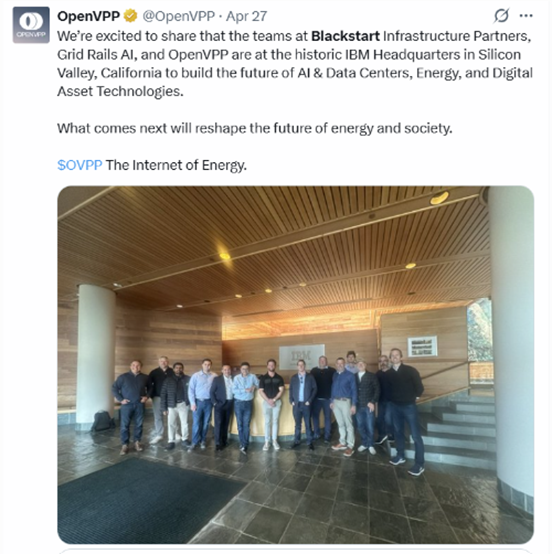
OpenVPP post, April 27, 2026.
June 2: Blackstart Appears in the City’s Permit Record
The City’s environmental-review file for the rezoning, ER26-088, was opened June 2. The record identifies:
Applicant: 650 Harry Road LLC
Payee: Chadwick Manning, Blackstart Digital
ePlan Applicant: Erik Schoennauer
Whatever administrative label the City’s permit system assigned to each participant, Blackstart was already formally connected to the rezoning more than two months before the Council vote.
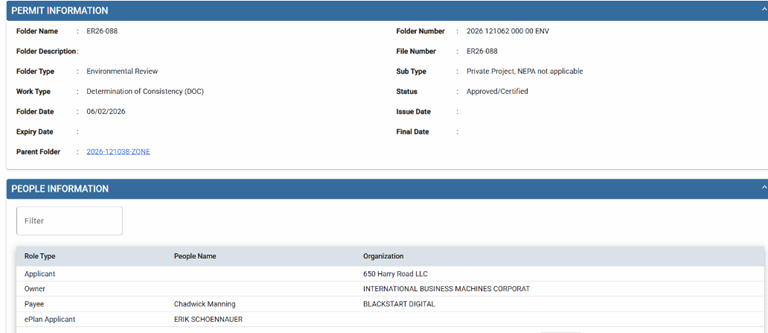
City of San José permit record for ER26-088.
August 18: “There’s No Project”
During the Council hearing, staff said no formal data-center application had been filed, but acknowledged a preliminary filing and discussions with applicants considering the use.
Then a Councilmember questioned why the rezoning couldn’t simply be delayed:
“since there’s no urgency to this and there’s no project to this, would a 30 day… hold be a problem?”
The response was revealing:
“So there is a project…” followed by “…not at the moment.”
There may not have been a formal Special Use Permit application for a data center. But by then, Blackstart and its partners had already been at the IBM campus discussing AI and data centers, and Blackstart was already connected to the City’s rezoning file.
That distinction matters.
What Schoennauer Told the Council
When Schoennauer addressed the Council, he described the rezoning as a way to modernize the old IBM zoning, preserve the surrounding open space and put the industrial portion of the property back into economic use.
He also said the rezoning was needed:
“To attract investment and financing, we have to have a logical and predictable process with no risks or roadblocks.”
And later:
“That’s the urgency is we’re trying to attract investment and financing…”
What he did not tell Council was that Blackstart and its partners had already publicly identified the IBM property with AI and data-center activity, or that Blackstart Digital was already connected to the City’s rezoning record.
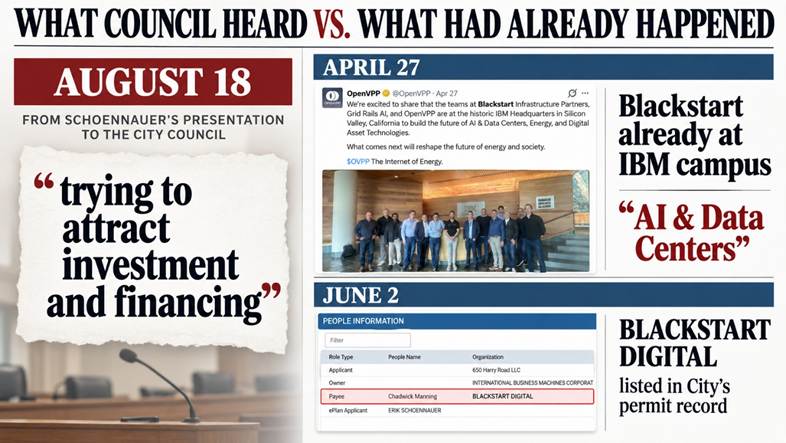
That is the disconnect at the center of this story.
Why I Believe the Council Was Misled
The City Council was not approving a data center on August 18. A future data-center project would still require additional City approvals. Those are important facts.
But they do not resolve the disclosure problem.
Councilmembers were considering whether to broaden the allowable uses of the IBM industrial property while a specific data-center company was already publicly connected to the site and appearing in the City’s own records.
The misleading part was not necessarily a direct statement that Blackstart did not exist or that nobody was considering a data center. It was the omission of information that materially changed the context of the rezoning request.
Councilmembers deserved to know that before deciding whether to approve the rezoning immediately or pause it for further review.
Then Blackstart Put It in Writing
By September 18, Blackstart’s own website made the situation considerably less ambiguous.
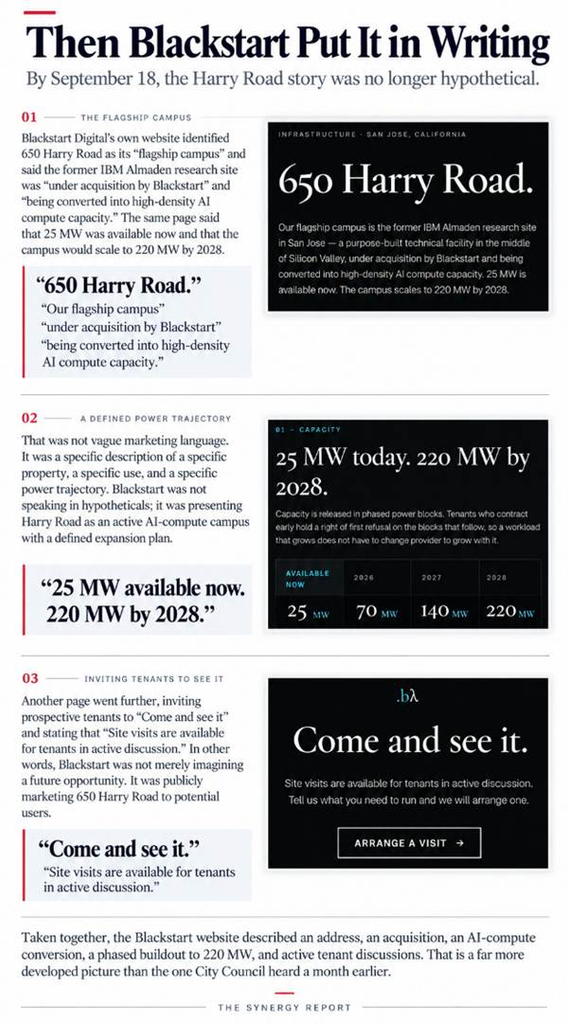
A month after the Council vote, Blackstart was publicly describing a defined site, an acquisition, an AI-compute conversion, a power buildout to 220 MW and prospective tenants already in active discussions.
That is a much more developed picture than the one Council heard in August.
The Full Timeline
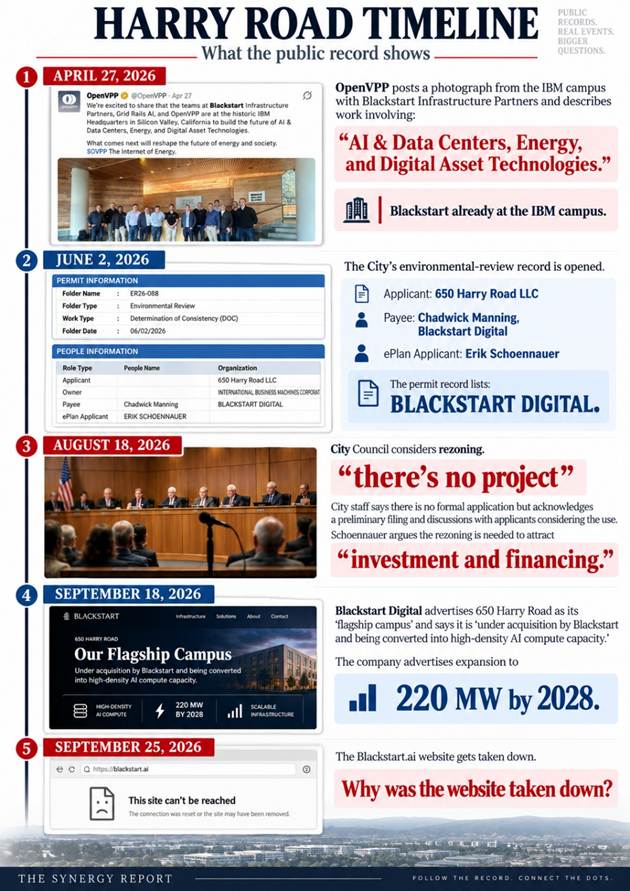
The sequence is difficult to ignore: Blackstart and its partners were at the IBM campus discussing AI and data centers in April; Blackstart Digital was connected to the City’s rezoning file in June; Council considered the rezoning in August; and by September Blackstart was marketing 650 Harry Road as its flagship AI-compute campus with a path to 220 MW.
The Blackstart.ai website was taken down on September 25. The website’s disappearance does not, by itself, prove wrongdoing. But given what had been posted there, it raises an obvious question about why the material was removed so quickly.
Why It Matters
This isn’t about whether the former IBM campus should remain vacant forever. It isn’t even, at this stage, about whether a data center could ever be appropriate on some portion of the property.
It is about disclosure and the integrity of the land-use process.
A Council vote can look very different when the question is:
Should we clean up outdated zoning on an old IBM research campus?
versus:
Should we change the zoning on a property where a specific company is already pursuing a major AI data-center campus?
The record does not show that San José had already received a formal 220 MW data-center application when the Council voted on August 18. Staff said it had not.
But Councilmembers also were not told that Blackstart and its partners had already been at the site discussing AI and data centers, or that Blackstart Digital was already connected to the City’s rezoning record.
In my view, that materially misled the San José City Council about what was really happening at Harry Road.
Blackstart has now said publicly that, “As ideas take shape, we will work through a full public process with the city of San Jose, neighbors, community leaders, conservation groups and open-space organizations.”
Source: San Jose Mercury News, Sept. 29, 2026 — “Tech startup strikes deal to buy landmark IBM campus in San Jose hills”
That commitment is welcome. But the company’s own public record shows that the idea had already taken shape months earlier.
By September, Blackstart’s website wasn’t describing a vague concept. It identified 650 Harry Road as its flagship campus, said the property was under acquisition and being converted to high-density AI compute capacity, laid out a path to 220 MW, and advertised site visits for tenants in active discussions.
That looks much more like a developed plan than an idea just beginning to take shape.
If Blackstart wants to demonstrate that its commitment to a full public process is meaningful, the next step should be straightforward: sit down now with the conservation and open-space organizations it says it wants to work with and negotiate a permanent conservation easement for the surrounding open space.
That would turn words about collaboration into something tangible.
And after the way the Harry Road rezoning unfolded, tangible commitments matter.